How to Hire Developers in Latin America
How to hire developers in Latin America: where to look, which hiring model fits, how to vet candidates, and what to settle before day one.

Table of Content expand_more
Hiring a senior developer in the U.S. can take months, and the search often ends with an offer you can't match. That's why more U.S. companies hire developers in Latin America: the talent works your hours, collaborates easily with U.S. teams, and can often start within weeks.
Hiring across a border still raises practical questions. Where do you find good candidates? How do you pay them legally? How do you know someone is actually senior? This guide walks through each step.
Why U.S. companies hire developers in Latin America
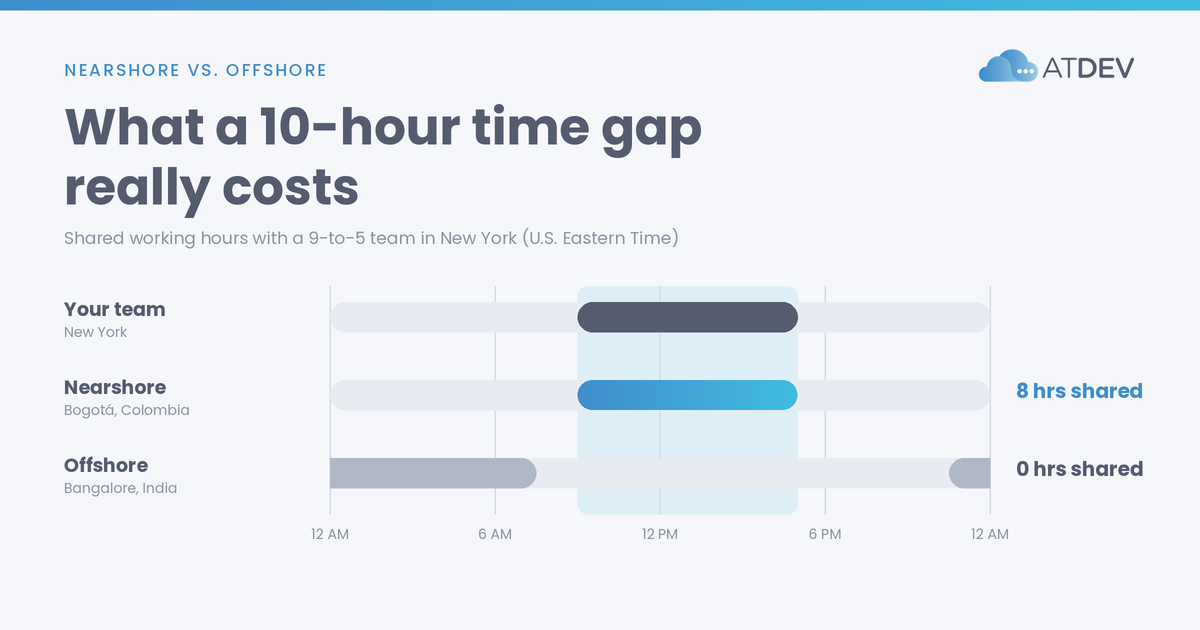
- Same workday. Most Latin American tech hubs are 0 to 3 hours from U.S. Eastern time, so developers join standups live and answer questions the same day. Here's what a time gap really costs when you hire farther away.
- Easy collaboration. Many Latin American engineers have years of experience on U.S. projects, which means fewer misunderstandings and faster feedback.
- A deep, growing talent pool. Tech hubs across the region produce senior engineers in Salesforce, Python, .NET, JavaScript, and Java.
- Speed. With the right partner, first candidates arrive in weeks, not months.
Where to look: the main tech hubs
Talent is spread across the region, but a few hubs come up again and again. Here's how each compares with U.S. Eastern time in winter:
- Mexico (Mexico City, Guadalajara, Monterrey): 1 hour behind
- Colombia (Bogotá, Medellín): same time
- Costa Rica (San José): 1 hour behind
- Dominican Republic (Santo Domingo): 1 hour ahead
- Brazil (São Paulo): 2 hours ahead
- Argentina (Buenos Aires): 2 hours ahead
Most of these countries don't change their clocks, so the gap shifts by an hour during U.S. daylight saving time. Either way, don't pick a country first. Pick the skills and working hours you need, then hire the best person who fits, wherever they're based.
Choose your hiring model
There are four common ways to hire developers in Latin America. The right one depends on how fast you need someone, how long you'll need them, and who will handle contracts and payroll.
1. Freelance marketplaces
Fast to start and fine for short, well-defined tasks. You do all the screening yourself, and quality varies widely. Freelancers often juggle several clients, so availability can change without notice.
2. A nearshore staffing firm (staff augmentation)
A nearshore staffing firm finds, vets, and employs the developer. They join your team and work your hours, and you direct their work, while the firm handles contracts, payments, and HR. Best when you need someone fast, part-time or full-time, without adding to your payroll.
3. Direct hire through a recruiter
A recruiter finds and evaluates candidates, and you hire the person onto your own team. Best when you want someone for the long term and are ready to manage the employment side.
4. Your own entity or an employer of record
Opening a local company, or using an employer of record (EOR) that employs people on your behalf, gives you full control. It also brings local labor law, payroll, and tax obligations, so it usually makes sense only for larger teams.
Whichever model you choose, contracts and payments must follow the rules in the developer's country. Talk to a lawyer who knows that country before your first hire.
How to vet Latin American developers
A shared time zone only helps if the person is strong. A solid evaluation covers five things:
- English. Your developer will join standups and talk to stakeholders. Test spoken and written English in a live conversation, not with a self-rating.
- Technical skills in your stack. Use a test built for the exact technology, reviewed by someone who works in it.
- A real-world assignment. A small task close to the actual job shows how they work, not just what they know.
- A senior technical interview. A senior engineer in the same stack can tell real seniority from a polished résumé.
- Soft skills and work style. Communication, ownership, and how someone handles feedback matter as much as code.
Doing this well is where most of the hiring time goes. At ATDEV, about 3 of every 200 applicants pass our five-stage evaluation on average, and you get a full report on each finalist before you meet them.
What to look for in a nearshore staffing firm
If you work with a nearshore staffing firm or a recruiter, the firm does most of the vetting for you. Before you sign, check four things:
- Specialization. A firm that recruits for every technology can't judge all of them well. Ask which stacks they actually evaluate in-house.
- Who runs the technical interview. It should be a senior engineer in the same stack, not a generalist recruiter.
- How English is tested. Ask how it's measured, not just whether it is.
- A team in Latin America. A firm with people on the ground understands local hiring, pay, and contracts.
That's how ATDEV works. We only recruit in the stacks we work in ourselves: Salesforce, Python, .NET, and JavaScript, plus Java, and the roles that keep projects moving: QA, DevOps, cybersecurity, databases, and project management. Every candidate is evaluated by a specialist in that stack, so we know what senior looks like in each one.
What to settle before day one
- Working hours, in writing and in your time zone.
- How you'll pay, and in what currency. Many Latin American developers prefer U.S. dollars.
- Equipment and access: laptop, accounts, VPN, and who provides each.
- Onboarding: a named point of contact, a first-week plan, and the first ticket ready to go.
- What happens if it isn't a fit? Agree on replacement terms before you need them.
Common mistakes to avoid
- Choosing on rate alone. A cheaper hire who needs constant rework costs more in the end.
- Skipping the English check. Weak communication is one of the most common reasons remote hires struggle.
- Leaving hours vague. "Flexible" can turn into zero overlap.
- Treating contracts as an afterthought. Misclassifying a worker or paying the wrong way creates legal and tax risk.
- No plan to keep people. Good developers get offers. Regular pay reviews and meaningful work keep them on your team.
How long does it take?
On your own, plan on several weeks of sourcing and interviewing before you make an offer. A partner with a vetted network is faster. At ATDEV, most staff augmentation roles get first candidates in 1 to 3 weeks, and Salesforce roles in as few as 5 business days. For direct hires, you receive up to three finalists within 15 business days.
The bottom line
Hiring developers in Latin America gives you senior talent on your own working day. The hard part isn't finding résumés. It's vetting candidates well and setting up the work the right way.
As a nearshore staffing firm, ATDEV has connected U.S. companies with Latin American tech talent since 2016. You can hire LATAM developers through our nearshore staff augmentation, or hire them onto your team through our IT recruiting service.
Planning your first hire in Latin America? Book a free discovery call, and we'll help you choose the right model for your role and timeline.
FAQ
Can a U.S. company legally hire developers in Latin America?
Yes. U.S. companies commonly hire through independent contractor agreements, a staffing partner, or an employer of record. The right setup depends on the country and the role, so check the local rules with a lawyer.
Do Latin American developers speak English?
Many do, especially those with U.S. project experience, but levels vary. Test English in a live conversation before you hire.
Which Latin American country is best for hiring developers?
There's no single best country. Mexico, Colombia, Brazil, Argentina, Costa Rica, and the Dominican Republic all have strong tech talent. Start with the skills and working hours you need.
How long does it take to hire a developer in Latin America?
Hiring on your own can take several weeks to a few months. With a partner that keeps a vetted network, first candidates often arrive in 1 to 3 weeks.