Nearshore vs. Offshore: What a Time Gap Costs
Nearshore vs. offshore isn't just about rates. See how many work hours you share with developers in Latin America vs. Asia, and what the gap costs.

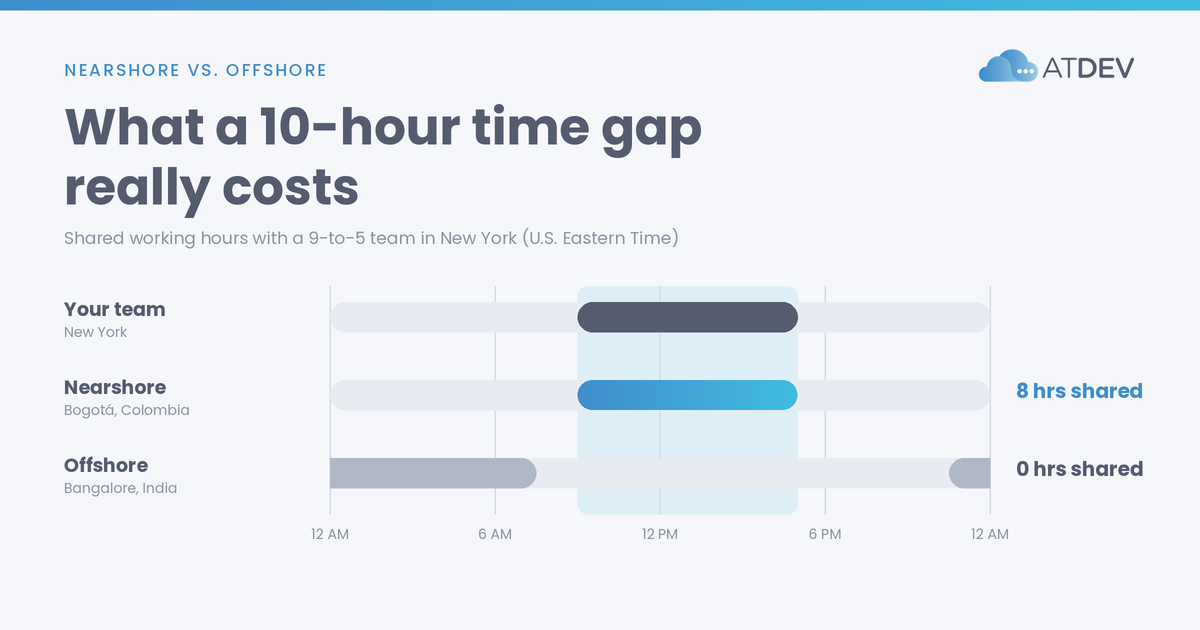
Table of Content expand_more
Your developer in Bangalore finishes a feature at 6 p.m. their time. It's 7:30 a.m. in New York. You review it at 10, spot a problem, and leave a comment. They see it tomorrow morning, which is midnight for you.
One round of feedback just took a full day. Nobody did anything wrong. That is simply how a 10-hour time gap works.
Offshore rates look cheaper on a proposal. The time gap is the cost that never shows up on the invoice. Here's how to put a number on it before you choose between nearshore and offshore.
Nearshore vs. offshore: the 30-second version
Offshore means hiring in a distant region, usually South or Southeast Asia or Eastern Europe, often 6 to 13 hours ahead of U.S. teams.
Nearshore means hiring in a nearby region. For U.S. companies, that's Latin America: Mexico, Colombia, Costa Rica, the Dominican Republic, Argentina, Brazil, and their neighbors, usually 0 to 3 hours from U.S. time.
Both models give you access to skilled engineers outside the U.S. market. The real difference is how many hours of your workday you share.
The overlap math
Assume your team works 9 a.m. to 5 p.m. Eastern. Here's how many hours a developer working a standard 9-to-5 in each city shares with you during U.S. winter time, and their local time when it's 9 a.m. in New York:
- Bogotá, Colombia: 8 shared hours (9 a.m. local)
- Santo Domingo, Dominican Republic: 7 shared hours (10 a.m. local)
- Mexico City, Mexico: 7 shared hours (8 a.m. local)
- São Paulo, Brazil: 6 shared hours (11 a.m. local)
- Kraków, Poland: 2 shared hours (3 p.m. local)
- Bangalore, India: 0 shared hours (7:30 p.m. local)
- Manila, Philippines: 0 shared hours (10 p.m. local)
Offshore teams can create overlap by working late, but only by stretching someone's day. Usually the offshore developer works into their evening, or your team takes calls before 8 a.m. That usually buys one or two shared hours, but it also means a lot of tired people.
Daylight saving time shifts things by an hour in spring, because most of the countries above don't change their clocks. The overall picture stays the same: Latin America shares most of your day, and South Asia shares almost none.
What the gap actually costs
1. Every question becomes a 24-hour question
Software work runs on small questions. Which field should this map to? Is this edge case in scope? Can you check the staging data?
With 7–8 shared hours, a question gets answered in minutes. With zero, it waits for the other side to wake up. A developer who hits a blocker at 3 p.m. their time often loses the rest of the day.
Here's a simple way to estimate it. If a developer hits three blockers a week, and each one costs most of a day in waiting, you lose roughly two to three days per two-week sprint. That's time you pay for while work sits still.
2. Meetings move to the edges of the day
Standups, sprint planning, and demos still need to happen. Someone takes them at 7 a.m. or 9 p.m. Over months, that is how good engineers burn out, and how meetings quietly get skipped.
3. Production problems wait
When something breaks at 2 p.m. Eastern, you want the person who wrote the code online now. With an offshore team, the fix often waits until their next morning, or depends on whoever answers a late-night call.
4. Management time goes up
Async teams can work well, but only with very detailed tickets, written specs, and recorded walkthroughs. Someone on your side has to write all of that. That someone is usually your most expensive engineer or your product lead.
5. Small misunderstandings grow
When feedback takes a day, a small misread can turn into three days of work in the wrong direction before anyone notices. Real-time conversation catches it in the first hour.
When offshore still makes sense
Offshore isn't the wrong choice for everyone. It can work well when:
- The work is well defined and stable, like long-term maintenance with clear specs.
- You want follow-the-sun coverage, where work hands off between time zones to cover 24 hours.
- Your team is already experienced at fully async work and has the documentation habits to support it.
- Hourly cost is the deciding factor, and timelines are flexible.
If your project changes weekly, depends on close collaboration with product or business teams, or needs fast answers, the time gap usually costs more than the rate difference saves.
How to evaluate a nearshore partner
Closer time zones only help if the people are strong. Before signing, ask:
- What are the developer's actual working hours? Get them in writing, in your time zone.
- How is English tested? Your developer will join standups and talk to stakeholders. Ask how it's measured, not just whether it is.
- How are candidates screened? Look for technical tests, a real-world assignment, and an interview with a senior engineer in the same stack. At ATDEV, about 3 of every 200 applicants pass our five-stage evaluation.
- Who handles contracts, payments, and time off? A good partner handles the administrative side, so you focus on the work.
- What happens if it isn't a fit? Ask how replacements work before you need one.
The bottom line
The nearshore vs. offshore decision isn't just about hourly rates. It's about how fast your team can move. If your work needs quick feedback, live collaboration, and same-day answers, shared working hours are worth more than the line item suggests.
ATDEV provides pre-vetted Latin American developers in Salesforce, Python, .NET, JavaScript, QA, and DevOps who work your business hours. See how our nearshore staff augmentation works.
Weighing nearshore against offshore for your next hire? Book a free discovery call, and we'll talk through your stack, your timeline, and the overlap your team needs.
FAQ
What is the difference between nearshore and offshore?
Nearshore means hiring in a nearby country with a similar time zone; for U.S. companies, that's Latin America. Offshore means hiring in a distant region, often 6 to 13 hours ahead, such as India, the Philippines, or Eastern Europe.
Is nearshore more expensive than offshore?
Hourly rates in Latin America typically run higher than in South Asia. Many teams find the difference shrinks once they count waiting time, late meetings, and extra management.
Which countries count as nearshore for U.S. companies?
Mexico, Colombia, Costa Rica, the Dominican Republic, Argentina, Brazil, Chile, and other Latin American countries, usually 0 to 3 hours from U.S. Eastern time.
How many hours of overlap do I need with a remote developer?
For most product teams, at least 4 shared hours a day covers standups, reviews, and quick questions. Nearshore teams in Latin America typically share 6 to 8.